What Does the Everest Base Camp Trek Involve?
The Everest Base Camp trek is a ~130 km round-trip journey on foot from Lukla to the base of Mount Everest at 5,364 m (17,598 ft), passing through the Khumbu region of Nepal. The route runs the length of Sagarmatha National Park, taking in Namche Bazaar, the monastery at Tengboche, and the moraine of the Khumbu Glacier, with nine of the 12–14 days spent walking. Readers whose first concern is financial may proceed directly to the cost breakdown.
A point of frequent confusion deserves settling at the outset: two Base Camps exist. South Base Camp (5,364 m, Nepal) is the destination of this trek and the subject of this page. North Base Camp (5,150 m, Tibet) is reached by vehicle on Tibet overland itineraries and involves no trekking of consequence. Note also that trekking to Base Camp is entirely distinct from climbing Everest; the $40,000+ figures circulating online describe summit expeditions, which operate under different permits, equipment, and risk profiles.
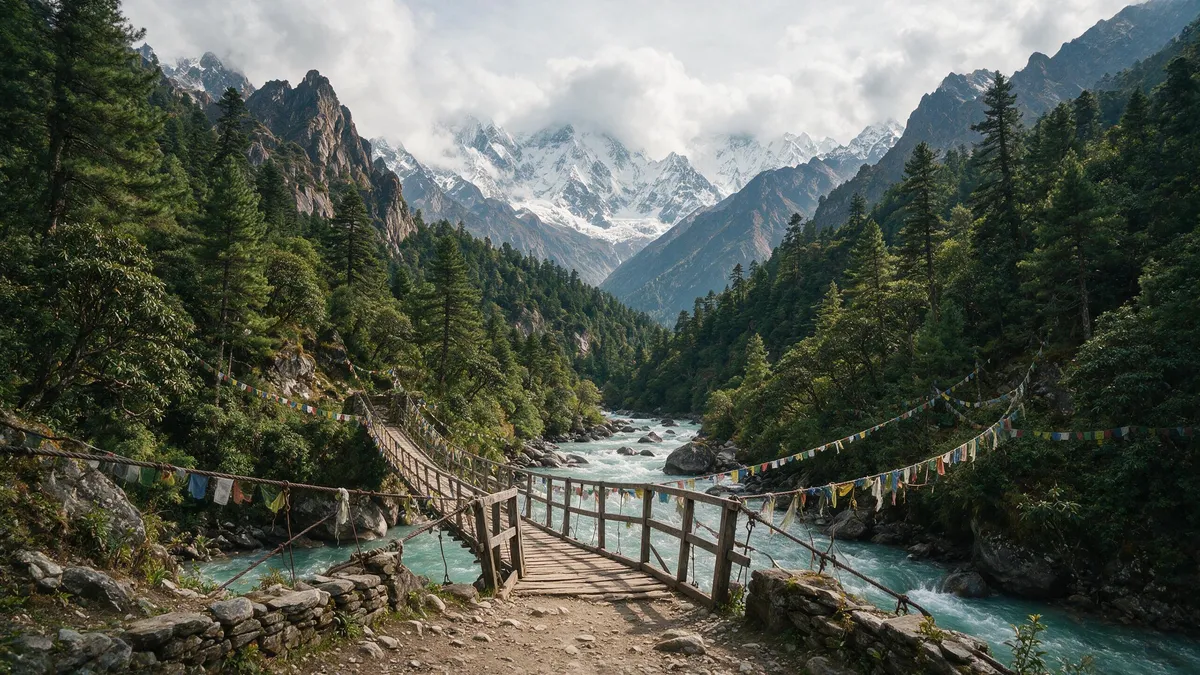
Which route variants exist?
Four established configurations serve the same destination:
- Classic EBC trek: 14 days, the standard out-and-back. The configuration this page plans.
- EBC via Gokyo Lakes: 13+ days, incorporating the Gokyo lake chain and Gokyo Ri.
- Three Passes trek: 18 days across Kongma La, Cho La, and Renjo La; the demanding circuit.
- Heli-return trek: 11 days, trekking up and flying out from the Kala Patthar area.
The geography is settled; the variable element is expenditure, which the next section addresses.
How Much Should You Budget for the Everest Base Camp Trek?
A standard guided 14-day Everest Base Camp trek package costs $1,250–1,800 per person, covering permits, Lukla flights, teahouse accommodation, meals, and a licensed guide. In practice the full market extends from roughly $950 at the minimal end to $5,000 for luxury-lodge itineraries. Solo travelers pay a meaningful premium, while parties of four or more secure the best per-person rates.
The following table itemizes a representative mid-range budget:
| Item | Typical cost (USD, 2026) | Notes |
|---|---|---|
| Guided 14-day package | $1,250–1,800 | Permits, flights, lodging, meals, guide included |
| Lukla flights (if booked solo) | $238 KTM / $188 Ramechhap one-way | ~$400 return all-in |
| Permits | $40–50 combined | Two permits; see permits |
| Nepal visa | $50 | 30 days, on arrival |
| Travel insurance | $100–250 | Must cover 6,000 m + helicopter evacuation |
| Tips | $100–200 total | ~$15/day guide, ~$8/day porter, per group |
| Drinks, wifi, charging, showers | $200–400 | Prices rise with altitude |
| Water | $1–2/L low, $3–6/L high | Boiled teahouse water: NPR 150–450/L |
For perspective, an uninsured helicopter evacuation from Gorak Shep costs $4,000–6,000. Insurance is accordingly the last item to economize on.
Three financial practices merit attention in advance. Cash management comes first: reliable ATMs end at Namche Bazaar, so trekkers carry Nepali rupees from Kathmandu sufficient for all on-trail incidentals. Second, altitude inflation applies to every purchase; the same water bottle rises from $2 in Lukla to $5 at Gorak Shep, while hot showers advance from $3 to $10 across the same span. Third, the figures above describe the standard route executed to plan, whereas delay nights, side excursions, and replacement gear purchased in Namche (available, at elevated prices) fall outside every package.
The independent alternative, for completeness: rooms, self-arranged flights, permits, and meals amount to approximately $900–1,100 before engaging any staff. The difference between that figure and a $1,250–1,800 package purchases the licensed guide Nepal's 2026 regulations now anticipate, porter support, confirmed peak-season rooms, and professional rebooking when Lukla weather disrupts the schedule. The premium is real, and what it buys is principally the removal of risk.
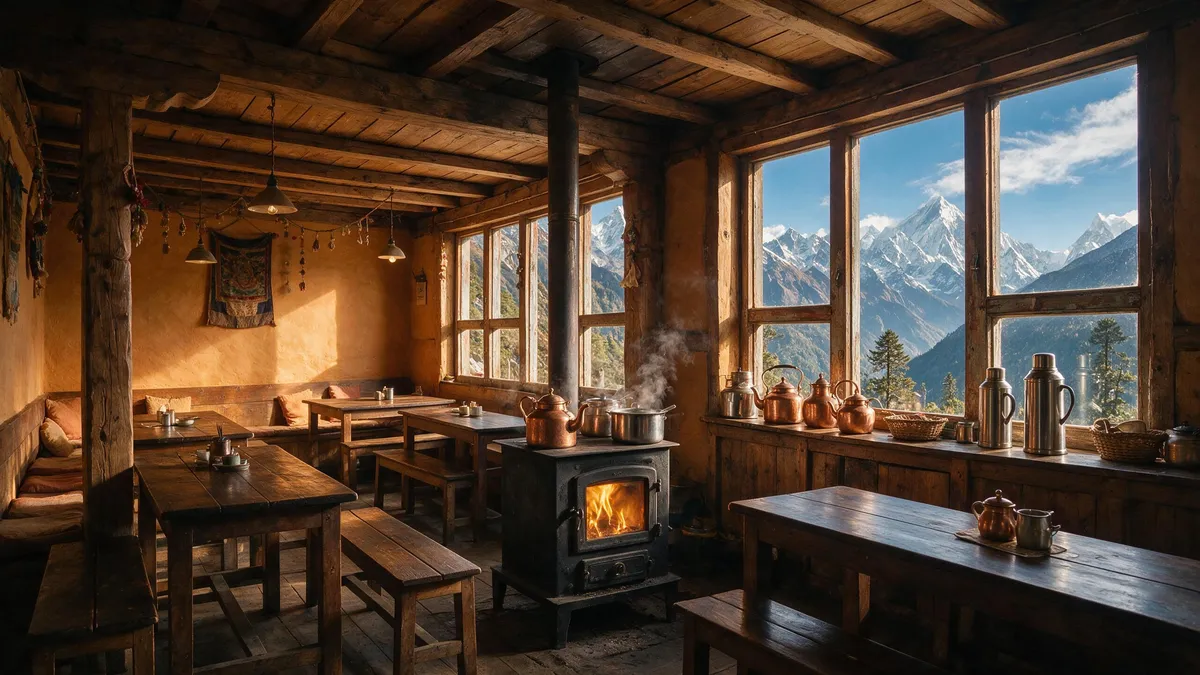
What moves the price?
Five variables determine the final figure:
- Group size: solo rates run approximately 40% above those for parties of 4–6.
- Service level: staffing ratios, room category, and the standard of Kathmandu hotels.
- Season: October–November and March–May command the highest prices.
- Trek length: the 11-day heli-return exceeds the 14-day walk in cost; helicopter economics explain the difference.
- Guided vs independent: dispensing with a package reduces fees, though Nepal's 2026 guide requirements make a licensed guide the working assumption. See permits.
Settling these five variables converts a price range into a price, which is precisely the function a defined package performs.
Which Everest Base Camp Trek Packages Are Available?
A standard Everest Base Camp trek package provides both permits, teahouse accommodation, a porter, three daily meals on trekking days, Lukla flights, and a licensed English-speaking guide. Standard exclusions comprise international airfare, the Nepal visa, insurance, beverages, tips, and personal equipment. Prudence requires reading both lists before any payment.
The packages this site's planning aligns with are operated by Himalayan360 of Kathmandu, whose record stands at 5/5 on TripAdvisor, "Excellent" on Trustpilot, and 5/5 on Google Reviews:
| Package | Days | From (pp) | Best for |
|---|---|---|---|
| Everest Base Camp Trek | 14 | $1,260 | First-timers; the standard plan |
| EBC Trek + Helicopter Return | 11 | $2,150 | Tight schedules; skip the descent |
| Gokyo Lake Trek | 13 | $1,200 | Lakes and Gokyo Ri over Base Camp itself |
| Everest Three High Pass Trek | 18 | $1,485 | Experienced trekkers; the full circuit |
| EBC Helicopter Tour | 1 | $1,070 | See EBC without trekking |
| Everest Mountain Flight | 1 hr | $215 | The budget aerial option |
Group-size pricing operates across all trekking packages; the 14-day classic, for instance, falls from $1,815 for a solo traveler to $1,290 per person in parties of 13–20.
Assessed plainly, the helicopter-return decision reduces to this: $890 extra buys back 3 days, substituting a 45-minute flight for the two-day descent. The arithmetic favors travelers with fixed return dates and disfavors those with fixed budgets.
Our trek began at Lukla with our seasoned guides who had in-depth knowledge of the trail, coupled with a genuine passion for the region.
Request an exact quotation for your dates
Each package reserves the same core sequence of trail days, set out below.
How Many Days Does the Everest Base Camp Trek Take?
The Everest Base Camp trek takes 12–14 days door to door from Kathmandu, comprising 9 trekking days and 2 scheduled acclimatization days. The standard 14-day program runs as follows:
| Day | Stage | Sleep altitude | Hours |
|---|---|---|---|
| 1 | Arrive Kathmandu | 1,400 m | — |
| 2 | Fly Lukla, trek to Phakding | 2,610 m | 3–4 |
| 3 | Phakding → Namche Bazaar | 3,440 m | 6–7 |
| 4 | Acclimatization day, Namche | 3,440 m | 3–4 hike |
| 5 | Namche → Tengboche | 3,860 m | 5–6 |
| 6 | Tengboche → Dingboche | 4,410 m | 5–6 |
| 7 | Acclimatization day, Dingboche | 4,410 m | 3–4 hike |
| 8 | Dingboche → Lobuche | 4,940 m | 5–6 |
| 9 | Lobuche → Gorak Shep → EBC → Gorak Shep | 5,164 m | 7–8 |
| 10 | Kala Patthar sunrise → Pheriche | 4,371 m | 7–8 |
| 11 | Pheriche → Namche | 3,440 m | 6–7 |
| 12 | Namche → Lukla | 2,860 m | 6–7 |
| 13 | Fly Kathmandu | 1,400 m | — |
| 14 | Depart | — | — |
Note that days 4 and 7, nominally rest days, are in fact the itinerary's working parts. Each schedules a high day-hike followed by a return to lower sleeping altitude, which is the mechanism by which the body adapts. Omitting them is the standard error on this route; the schedule exists to regulate altitude exposure rather than distance.
The stages themselves reward attention. Day 3 includes the Hillary Suspension Bridge crossing above the Dudh Koshi and the sustained climb into Namche Bazaar, a market town set in a natural amphitheater and known for its Saturday market. Day 5 concludes at Tengboche, whose monastery is the largest gompa in the Khumbu, positioned directly beneath Ama Dablam. Day 9 delivers the objective: during April and May, Base Camp operates as an expedition settlement of several hundred tents on the Khumbu Glacier, while autumn presents the empty glacier and its prayer-flag marker. The night is spent at Gorak Shep, which served as the original Base Camp for the 1953 expedition.
Compression is available within limits. The 11-day heli-return eliminates the descent, a legitimate saving. Removing acclimatization days, by contrast, removes the safety architecture; itineraries advertising 10 walking days offer elevated altitude-sickness risk rather than efficiency. The reasoning becomes clear once the difficulty profile is understood.
How Demanding Is the Everest Base Camp Trek?
The Everest Base Camp trek is challenging yet non-technical, requiring no ropes, no climbing, and no mountaineering experience. It's fundamentally a long walk conducted in progressively thinner air. Daily stages cover 8–15 km across 5–7 hours on rocky, stepped, and occasionally steep terrain, and the cumulative load of nine consecutive walking days constitutes the true test rather than any individual stage.
A prepared beginner completes this trek. The prerequisites are the capacity to walk 5–7 hours on consecutive days under a light daypack, together with adherence to the standard acclimatization itinerary. No official completion figure is published, though operators report that most trekkers on 12–14-day programs reach Base Camp.
Allocate 8–12 weeks to preparation:
- Develop cardiovascular capacity across 3–4 weekly sessions of hiking, stair work, running, or cycling.
- Schedule consecutive weekend hikes of 4–6 hours under a loaded daypack.
- Introduce 8–10 kg of carried weight on stair or hill sessions from week 4.
- Complete the breaking-in of trekking boots well before departure, as unworn boots terminate treks.
The daily pattern clarifies the demand. Departure follows breakfast at 7–8 am, with 3–4 hours of walking before lunch and a further 2–3 to the evening's teahouse, targeting arrival by mid-afternoon. The trekker carries only a daypack containing water, layers, sun protection, and a camera, the duffel having gone ahead with the porter. Underfoot conditions alternate among river-corridor trail, stone steps, and high moraine beyond Lobuche, none of which requires the use of hands.
As benchmarks: overall demand is comparable to Kilimanjaro, though EBC distributes its altitude across more days while Kilimanjaro concentrates a single higher push to 5,895 m. Both routes exceed the Inca Trail in length, elevation, and cold. The dominant cause of failure on this route is excessive ascent speed rather than inadequate fitness, which directs attention to the subject of altitude.
How High Is the Everest Base Camp Trek, and How Does Acclimatization Work?
Everest Base Camp stands at 5,364 m (17,598 ft), an elevation at which each breath supplies approximately half the oxygen available at sea level. Kala Patthar, the route's true high point and principal viewpoint, adds a further 181 m at 5,545 m. The defining risk of this trek is therefore atmospheric rather than topographic, and it is governed by protocol rather than fortitude.
Acute mountain sickness (AMS) may affect any individual above roughly 2,500 m regardless of conditioning. Initial presentation includes headache, nausea, fatigue, and disturbed sleep. The severe progressions, HACE (cerebral edema) and HAPE (pulmonary edema), constitute medical emergencies. Ascent rate, not fitness, is the controlling risk factor.
The itinerary functions as the prevention system:
- Two acclimatization days: scheduled at Namche (3,440 m) and Dingboche (4,410 m), each structured around a climb-high-sleep-low excursion.
- Slow gains above 3,000 m: sleeping elevation advances approximately 400–500 m per day, consistent with accepted guidelines.
- Hydration and pacing: both enforced by guides, given that dehydration reproduces and aggravates AMS symptoms.
Regarding medication: acetazolamide (Diamox) is commonly carried following pre-departure medical consultation, and competent guides conduct daily oximeter checks. Neither measure substitutes for the acclimatization days, and no pharmaceutical renders a 10-day itinerary safe.
Two recurring questions belong here. The "2 pm rule" refers to a summit climbers' turnaround convention, namely reaching the top by early afternoon or abandoning the attempt. Its trekking equivalent is arrival at each night's teahouse by mid-afternoon, ahead of deteriorating weather. Insurance documentation, meanwhile, must state coverage to 6,000 m including helicopter evacuation, since standard travel policies terminate at 3,000–4,000 m and decline Gorak Shep airlifts accordingly.
Altitude risk carries a seasonal dimension as well, since adverse weather narrows every margin. Season selection is therefore examined next.
Which Months Are Best for the Everest Base Camp Trek?
October–November and March–May are the optimal windows. The post-monsoon autumn delivers the year's clearest atmosphere, while pre-monsoon spring offers warmth, rhododendron bloom, and the activity of the climbing season at Base Camp itself.
| Months | Conditions | Crowds | Lukla flights |
|---|---|---|---|
| Oct–Nov | Clearest views, stable, cold nights | Peak | Mostly via Ramechhap |
| Mar–May | Warm days, blooms, some late haze | High | Mostly via Ramechhap |
| Dec–Feb | Clear and very cold (−15 °C nights up high) | Low | From Kathmandu |
| Jun–Sep | Monsoon: cloud, rain, leeches low down | Lowest | Frequent cancellations |
Winter remains viable for the cold-tolerant, offering empty trails and exceptional clarity against reduced teahouse services. The monsoon months are the single window to exclude, as visibility collapses and flight reliability follows. Season selection also determines the airport of departure, a detail that routinely surprises first-time planners.
How Do You Reach Lukla and the Trailhead?
The trek commences at Lukla (2,860 m), served by a 30-minute flight from Kathmandu or a 20-minute sector from Ramechhap. In practice, during peak seasons (October–November, March–May) the majority of Lukla services operate from Ramechhap/Manthali airport, a 4–5 hour pre-dawn drive from Kathmandu, an arrangement forced by congestion at Kathmandu's airport. Outside those windows, departures revert to Kathmandu. Published fares for foreign nationals stand at $238 from Kathmandu and $188 from Ramechhap, one-way.
The airport itself accounts for the operational caution. Tenzing-Hillary Airport comprises a single sloped runway of 527 m at approximately 12% gradient, terminating against rising ground at one end and open air at the other. All operations proceed under visual flight rules: no instrument approaches exist, so cloud closes the field entirely. The daily pattern is consistent, with mornings operating and afternoons deteriorating. Early slots are accordingly the correct booking. Contingency planning proceeds as follows:
- Reserve 1–2 buffer days ahead of international connections.
- Prioritize morning departures, as afternoon services carry materially higher cancellation rates.
- Note that helicopters operate in marginal weather that grounds fixed-wing aircraft: $450 per seat shared, approximately $3,500 for private charter.
- Retain the road alternative (drive to Surke/Thamdanda and walk in) as a fallback, at a cost of 1–2 additional days each way.
Package clients have flights included and rebooked on disruption; independent trekkers manage their own recovery. The first permit checkpoint follows within a day's walk of Lukla, which brings the documentation into scope.
Which Permits and Documents Does the Trek Require?
Two permits govern the standard route, verified at Lukla and Monjo:
| Document | Cost (foreigners) | Where |
|---|---|---|
| Sagarmatha National Park Entry Permit | NPR 3,000 (~$22) | Kathmandu or Monjo gate |
| Khumbu Pasang Lhamu Rural Municipality Permit | NPR 3,000 (~$22) | Lukla |
| Nepal tourist visa | $50 / 30 days | On arrival, airport |
Combined permit expenditure amounts to roughly $40–50. The Jiri overland approach also requires a Gaurishankar Conservation Area permit. Package operators administer the entire set.
On the guide question: Nepal has instituted licensed-guide requirements for the Everest region, and given 2026 enforcement within Sagarmatha National Park, prudent planning assumes a guided trek. The regulation formalizes what the safety analysis already indicated, namely that a licensed local guide represents the highest-value allocation in the entire budget.
What Belongs on Your Everest Base Camp Packing List?
The packing list organizes around a single anchor item: a sleeping bag rated −10 to −20 °C. Teahouses supply beds and blankets but no heating in the rooms. Seven categories complete the kit:
- Layered clothing: a base-layer system under fleece, insulated jacket, and waterproof shell
- Broken-in boots accompanied by camp footwear
- Sleeping bag at the −10 to −20 °C standard, plus liner
- Sun protection: category-4 glasses, high-SPF cream, and a brimmed hat, as high-altitude sun burns through cold air
- Water treatment: purification tablets or a filter, untreated water being unsafe throughout the route
- First aid and personal meds: with blister management and any prescribed altitude medication
- 30–40 L daypack: the porter-carried duffel is limited to ~10–15 kg
Conditions on the trail are austere but orderly. Accommodation consists of twin rooms with shared facilities; dal bhat is the dependable choice on every menu, customarily refilled; and charging, wifi, and hot showers are billed per use at rates that rise with elevation. After dark the dining-room stove provides the only heated space, which explains the sleeping-bag specification. Namche Bazaar constitutes the final point of genuine resupply, so omissions are correctable there at a premium and nowhere beyond. The allowance for such extras appears in the cost table. Equipment settled, one question remains, and it's the question most planning begins with.
Is the Everest Base Camp Trek Worth Doing?
For the majority of trekkers, yes, subject to one honest disclosure: Everest's summit isn't visible from Base Camp itself, as Nuptse intervenes. The route's defining reward arrives instead at the Kala Patthar sunrise, when Everest, Lhotse, and Ama Dablam stand illuminated above the Khumbu Glacier. The trek's value accrues across the whole undertaking: nine days through the highest landscape on earth, the villages and monasteries of the Sherpa homeland, and an endpoint at mountaineering's most storied location.
As we trekked through diverse landscapes, I was spellbound looking at the majesty of nature, and each step felt magical... Grateful to the team at Himalayan 360 for making this trip a success with your exceptional service and expertise.
Request a trek plan
Submit your preferred month and group size to receive a tailored itinerary and quotation. Treks from $1,260, operated by Himalayan360 (TripAdvisor 5/5 · Trustpilot Excellent · Google 5/5).
Request a trek plan
Frequently Asked Questions
- Can you see Mount Everest from Base Camp?
- No. The summit is concealed behind Nuptse at Base Camp; the Everest view belongs to Kala Patthar (5,545 m) on the following morning.
- Can a beginner do the Everest Base Camp trek?
- Yes. First-time trekkers who complete 8–12 weeks of preparation manage the standard 14-day itinerary, with the two acclimatization days performing the specialized adaptation work.
- Do planes fly over Mount Everest?
- Commercial aviation routes around the summit rather than over it, and dedicated mountain flights from Kathmandu present the range at viewing distance for approximately $215.
- Why does climbing Everest cost $40,000 or more?
- Figures of that order fund summit expeditions, including climbing permits, supplemental oxygen, Sherpa support, and weeks of residence above Base Camp, none of which applies to this trek.
- What is the oxygen level at Everest Base Camp?
- Atmospheric oxygen at 5,364 m stands at roughly 50% of the sea-level supply, which is the reason the itinerary paces altitude exposure so deliberately.
- How do I book an Everest Base Camp trek?
- Submit your preferred month and party size via the trek plan form; a tailored itinerary and exact quotation follow, with flights, permits, and teahouses administered by the operator.
The brief is complete. Plan the Everest Base Camp trek against the figures above, allow preparation its 8–12 weeks, and the remainder is the mountain's business.